
The Puzzle of Predicting Protein Function Continues: AlphaFold and Beyond
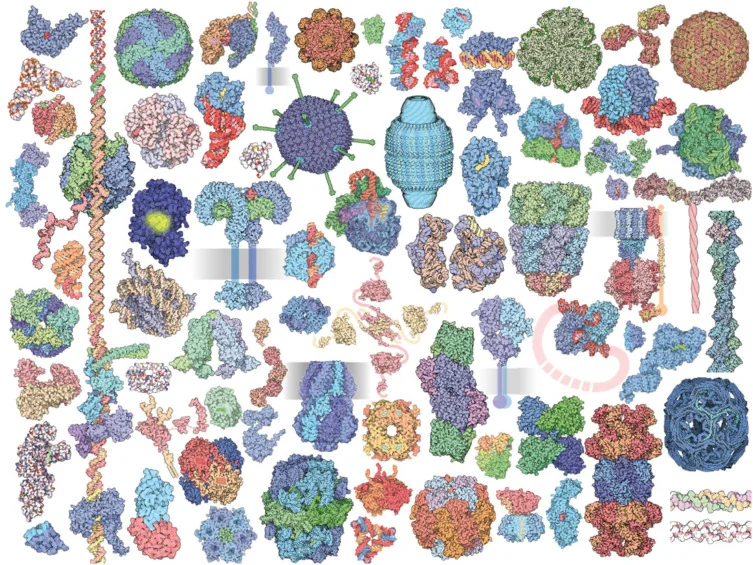
Amino acids, commonly referred to as the “building blocks of life”, are not merely the brick and mortar of all living things.1,2 These twenty molecules combine to form all of the proteins that make up organisms.2 There are proteins that shuttle molecules across membranes and others that prevent the water inside cells from freezing. Some proteins fluoresce, carry oxygen, detect light, and generate movement. Still others regulate genes, make fingernails, and even regulate heart rate2. How can these molecules, all composed of the same twenty amino acids, serve such disparate functions?
To begin to understand the basis for these functions, the field of biology turns to an examination of protein structure. To understand a protein’s structure is to understand its function.3 This dogma, which has long been the underlying principle of the field of structural biology, was officially coined in the early 1950s by the American biochemist Christian Anfinsen.3 While Rosalind Franklin and Maurice Wilkins were working at King’s College to produce the X-ray diffraction images that led to the landmark structural characterization of DNA, Anfinsen and his colleagues at the National Institutes of Health were using this same technique to understand proteins. 4,5
X-ray crystallography is an imaging technique that allows for three-dimensional visualization of structures at the molecular level.6 As this method began to be increasingly utilized in the 1950s, the strange configurations of proteins began to come into view. 7 Anfinsen was curious about these odd, irregular structures. How did the amino acid chain assume these shapes? To probe the “how” of protein folding, Anfinsen used two compounds that selectively dissolve specific bond types: β-mercaptoethonal, which dissolves covalent disulfide bonds, and urea, which dissolves all non-covalent bonds.4 When these two compounds were added, all the bonds in the protein dissolved, resulting in the protein losing its three-dimensional structure.4 When Anfinsen removed these compounds, he observed that the string of amino acids, which had lost its stable, complex structure, spontaneously re-folded into its original, biologically active conformation.4 These observations suggested that the information which directs protein folding was somehow contained in the amino acid sequence as opposed to originating from external environmental conditions or some other “folder” protein.4
Anfinsen’s conclusion, that sequence determines structure and structure determines function, won him the 1972 Nobel Prize in Chemistry.4 Given that researchers were already able to determine the amino acid sequence of a protein, it appeared as though prediction of structure, and therefore function, would be on the horizon. If protein structure could be determined without direct imaging, this would allow for tremendous advancement in the rate at which scientists could understand the function of these molecules. And, if function could be so effectively predicted, identifying the correspondence between gene mutation and structural consequence would become quite straightforward.8 Solving this Protein Folding Problem (PFP) would allow scientists to “read” the protein function from the amino acid sequence, an advance in scientific literacy with the potential to revolutionize the field of molecular biology.4,8
While the partial solving of the PFP has proved to be revolutionary, its magnitude was not felt until this past decade.9 Despite the ease of determining a protein’s amino acid sequence, or primary structure, there were some aspects of this phenomenon the field could not yet understand.10 How did these chains fold into the correct structure within seconds when there are hundreds of thousands of possible configurations it could assume?10 To accurately predict the most stable structure, a model would have to account for each of the twenty amino acid residues’ combination of unique structure, charge, polarity, and acidic property.10 Each amino acid then interacts with adjacent and non-adjacent residues as the chain folds and interacts with the cell environment.10
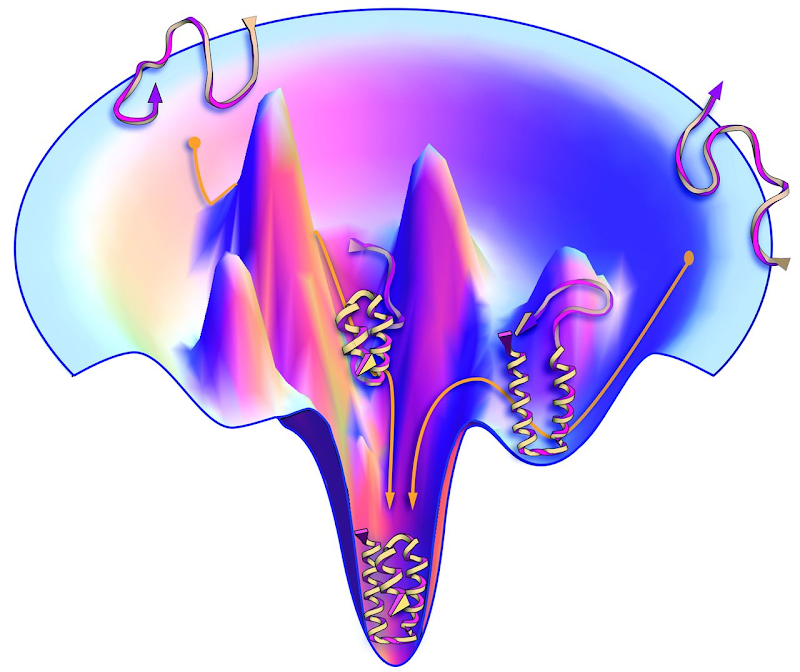
The protein will assume the structure that exists at the lowest Gibbs free energy level, or, simply put, is the most stable conformation.11 To accurately predict this, all of the properties and interactions occurring within a protein must be accounted for.9 This requires a tremendous amount of data, and it is no surprise that progress towards a solution to this PFP has come with the advent of Large Language Models (LLMs).9
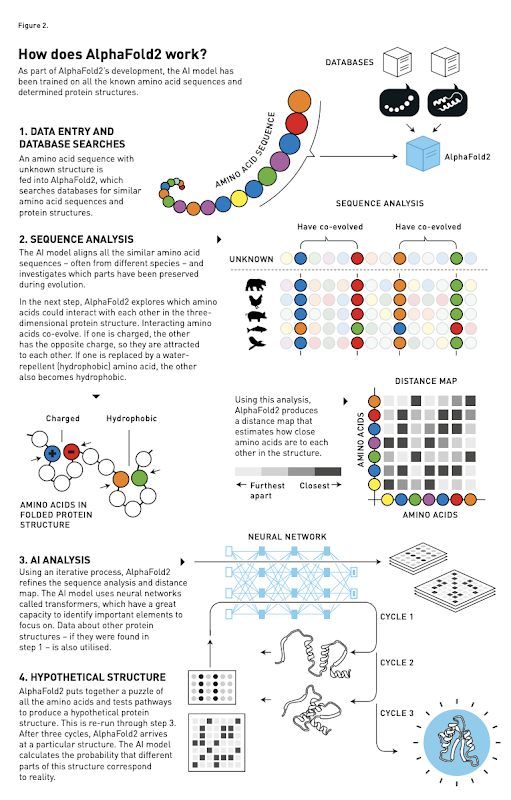
However, the most famous, effective, and lauded software, AlphaFold, does not build its protein models by considering all these complex forces.9 Instead, this neural network system references already known structures, compares their sequence to the one it is working to predict, and then spits out a generated best guess of the relative locations of the amino acids. 9,10 Invented by John Jumper and Demis Hassabis of Google DeepMind, AlphaFold technology was so accurate in its prediction of protein structure that it was awarded the 2024 Nobel Prize in Chemistry.4 With AlphaFold, the solution to the longstanding PFP posited over fifty years ago appears to have arrived.8
The software, like most predictive software, suffers from hallucinations.9 The model’s newest iteration, AlphaFold3, has reduced the incidence of this problem, especially when predicting intrinsically disordered regions (IDRs).9 As the name implies, these stretches of the protein do not assume a particular structure.2 Despite the fact that depicting inherent structural uncertainty present in these regions is a somewhat challenging task for software tasked with providing definitive predictions of protein structure, AlphaFold3’s specific training has improved its accuracy.9
But beyond these diminishing issues of precise prediction, there are more interesting problems emerging.
One functionally important aspect of proteins that structural modeling does not account for is homology. Homologous proteins are distinct proteins existing in different organisms that originated from a common gene in a common ancestor.13 Over time, these protein structures diverge from one another, or, to be more specific, the number of differences between homologous proteins increases over time.13 Given Anfinsen’s dogma, it would follow that function diverges in proportion to structural differences. However, this is not observed.13 Homologous proteins retain similar functions as their sequences diverge.13 Conversely, convergent non-homologous proteins, that is, proteins which originate from different genes but become more similar, do not display a corresponding convergent function.13 This discrepancy between structure and function is not able to be explained under the current paradigm.
A second inconsistency between structure and function is the inherent dynamic character of proteins in vivo. The static, most stable configuration is not the one in which the protein always exists14. In fact, a protein is an animated structure whose conformation and energy are constantly fluctuating.15 IDRs, the regions that never assume a fixed structure but instead bend and flex constantly based on thermal energy changes, are perhaps the most well-known example of this phenomenon.2 There are even entire proteins that never assume a specific structure, known as IDPs.15 Even within proteins that are known to assume a specific structure, the field of protein dynamics asserts that this structure should be thought of as heterogeneous, meaning that it is fundamentally different at different points in time.14
Many in the field believe that AlphaFold has solved the PFP, and all that remains is the refinement and proliferation of this characterization project. 8,16 However, the fact remains that much about protein function is not able to be understood from these structural models alone.15 Given that the function of each protein lies in its interaction with other similarly dynamic structures, how could a static characterization of its structure be expected to provide the entire functional story? AlphaFold, along with other related neural networks, has provided tremendous insight into the world of proteins.8 This technological advancement has revolutionized the field of protein biology, and at the same time, revealed how the structure of our understanding of protein function is itself fluctuating, not fixed.
References
1. Tserodze, N., Karkashadze, N., Tatiashvili, L., Kavtaradze, N., Uridia, R., & Tserodze, K. (2023). IMPORTANCE OF AMINO ACIDS. Georgian Scientists, 5(2), 229–233. https://doi.org/10.52340/gs.2023.05.02.30
2. Alberts, B.; Hopkin, K.; Johnson, A. D.; Morgan, D.; Raff, M.; Roberts, K.; Walter, P. Essential Cell Biology, 5th ed.; W. W. Norton & Company: New York, 2019.
3. Dill, K. A.; MacCallum, J. L. The Protein-Folding Problem, 50 Years On. Science 2012, 338 (6110), 1042–1046. https://doi.org/10.1126/science.1219021
4. Nobel Prize Outreach. Christian Anfinsen—Biographical. NobelPrize.org. https://www.nobelprize.org/prizes/chemistry/1972/anfinsen/biographical/
5. Nobel Prize Outreach. Maurice Wilkins—Facts. NobelPrize.org. https://www.nobelprize.org/prizes/medicine/1962/wilkins/facts/
6. Deschamps, J. R. X-Ray Crystallography of Chemical Compounds. Life Sci. 2010, 86 (15–16), 585–589. https://doi.org/10.1016/j.lfs.2009.02.028
7. Nobel Prize Outreach. John Kendrew—Facts. NobelPrize.org. https://www.nobelprize.org/prizes/chemistry/1962/kendrew/facts/
8. European Molecular Biology Laboratory’s European Bioinformatics Institute. AlphaFold Protein Structure Database—About. AlphaFold Protein Structure Database. https://alphafold.ebi.ac.uk/about
9. Lowe, D. AlphaFold 3 Debuts. In the Pipeline, Science. https://www.science.org/content/blog-post/alphafold-3-debuts (accessed 2026-11-14).
10. Magana Gomez, P. G.; Kovalevskiy, O. What Is AlphaFold? EMBL’s European Bioinformatics Institute. https://www.ebi.ac.uk/training/online/courses/alphafold/an-introductory-guide-to-its-strengths-and-limitations/what-is-alphafold/ (accessed 2026-11-14)
11. Kocher, C. D.; Dill, K. A. Origins of Life: The Protein Folding Problem All over Again? Proc. Natl. Acad. Sci. U.S.A. 2024, 121 (34), e2315000121. https://doi.org/10.1073/pnas.2315000121
12. Lee, J. C. Does Sequence Dictate Structure Which Dictates Function? Int. J. Struct. Comput. Biol. 2017, 1 (2), 3.
13. ScienceDirect. Homology—An Overview. ScienceDirect Topics. https://www.sciencedirect.com/topics/engineering/homology (accessed 2026-11-14).
14. Medina, E.; Latham, D. R.; Sanabria, H. Unraveling Protein’s Structural Dynamics: From Configurational Dynamics to Ensemble Switching Guides Functional Mesoscale Assemblies. Curr. Opin. Struct. Biol. 2021, 66, 129–138. https://doi.org/10.1016/j.sbi.2020.10.016
15. Nam, K.; Wolf-Watz, M. Protein Dynamics: The Future Is Bright and Complicated! Struct. Dyn. 2023, 10 (1), 014301. https://doi.org/10.1063/4.0000179
16. Lowe, D. AlphaFold Excitement. In the Pipeline, Science. https://www.science.org/content/blog-post/alphafold-excitement
Spotted an error? Email [email protected] from your Wesleyan account.