Better, Not Brighter: The Cost of Wesleyan’s Lights
Like many of you, I love Foss Hill. I love lying around in the sun when the procrastination hits– eating my food truck lunch as all my napkins fly away. But most especially, I love to stargaze. On a clear night on Foss, the view can be breathtaking – glimmers of light poking into our sky, saying hello as I rest my head on the soft grass.
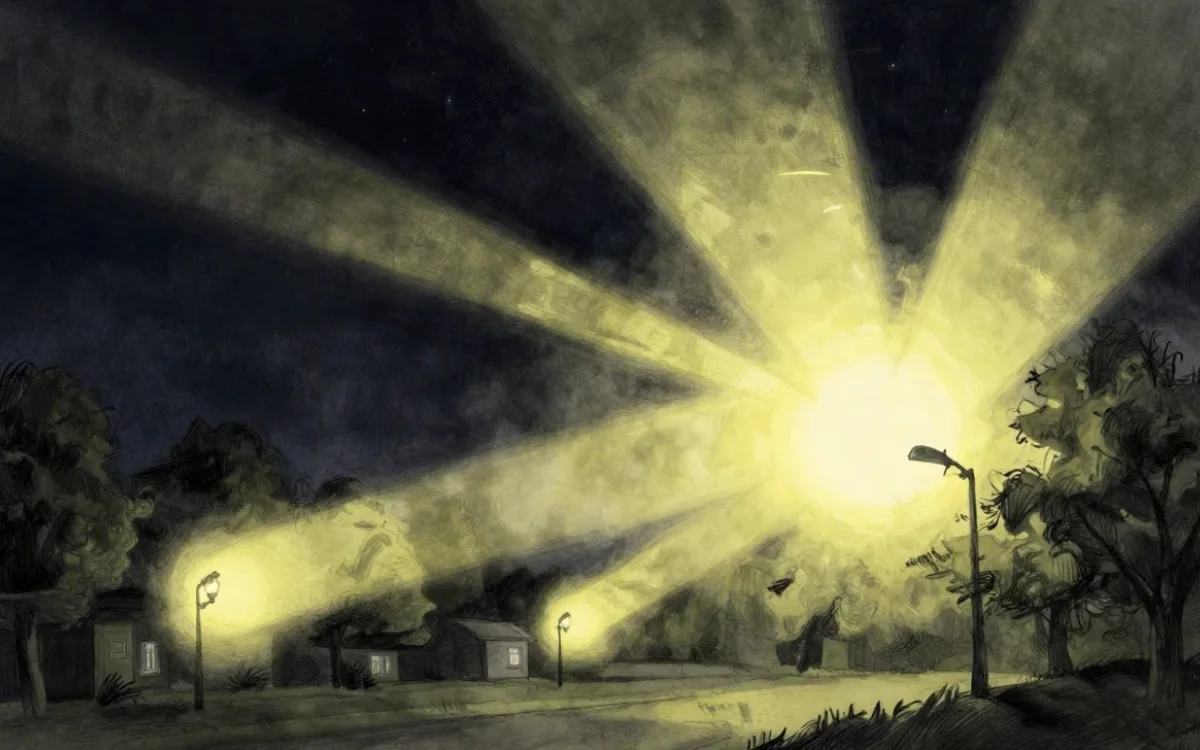
But then I turn my head, and I find that glimmering moment is over. Olin Library is lit up like a football stadium on game night. Its lights pour in harsh white brightness across the steps and straight into the sky – where, last I checked, no one was doing any studying. Behind it, the rest of campus joins in: glaring lampposts, glowing windows, and Usdan all lit up like the school is about to host a campus-sized surgery. Together, they paint a hazy and harsh dome over Foss, and one by one, those glimmers of light fade away. On my best nights, I can count a couple dozen stars. Under a dark sky that doesn’t exist, there would be thousands.
Not one bit of that light bleeding into the sky is helping anyone. It’s just wasted.
It’s light pollution, and Wesleyan is hardly the only perpetrator. Light pollution is what happens when light goes where it isn’t needed – up into the sky as a harsh glow, sideways into tired college dorms, or straight into our eyes as glare. A 2016 study in Science Advances, “The New World Atlas of Artificial Night Sky Brightness,” found that nearly 80% of North Americans can no longer see the Milky Way from where they live.1 And the sky is only getting worse: a 2023 study in Science, built on over 51,000 observations from everyday stargazers, found that the night sky is continuing to get 7-10% brighter every single year.2
Wesleyan astronomers have been battling this brightening sky for decades. The late Professor Arthur Upgren, former director of VVO (Van Vleck Observatory), was remembered as “a tireless advocate for intelligent lighting on the Wesleyan campus.”3 In the present day, the astronomy department holds a Dark Skies forum every few semesters to keep light pollution on our minds. However, all this work can only do so much when the glow comes bleeding in from everywhere else.
Now, you’re probably asking, “But Zesun, I’m not an astronomy major. Why should I care?” I get it – not everyone wants to spend their nights counting stars on Foss Hill. But bad lighting doesn’t stop at the edge of campus, and it doesn’t only affect astronomers.
Middletown is our home too. In 2020, the city swapped approximately 5,000 streetlights for LEDs, saving energy and over $200,000 a year.4 However, the type of LED that they used is crucial. The American Medical Association has warned that bright, blue-white LEDs suppress melatonin, the hormone that tells our bodies it’s time to sleep, and recommends warmer lights around 3000K or below.5 And for neighbors living next to our brightly lit campus, that light doesn’t just stay on campus – it shines right into their homes.
Aside from all of that, you also have the effects that these harsh lights have on everything else that lives here at night. Artificial light throws off how insects feed, mate and navigate.6 Birds have it rough as well. Connecticut sits under a major migration route, and bright lights can pull migrating birds off course. When researchers studied New York City’s 9/11 Tribute in Light, they found the nearby birds slowing down, crowding into the beams until the lights were finally turned off.7 In all these cases, every watt we send shooting into the sky is a watt we pay for and burn for nothing.
A point that seems to be brought up a lot in the conversation of harsh lighting is the safety aspect. Walking home alone at night is a very scary experience, and at many times a very real danger, a sentiment shared by our community at Wesleyan and around the world.8 To be clear, nobody is asking anyone to walk around in pitch black.
But “more light” and “safer” aren’t actually the same thing, and the research is more mixed than you’d think. A 2019 experiment in New York City public housing, published by the National Bureau of Economic Research, did find that adding lights cut serious nighttime crime.9 However, a large review of lighting studies in Campbell Systematic Reviews found crime dropped just as much during the day, which suggests the change had more to do with people seeing their neighborhood cared for than with brightness itself.10 When towns across England and Wales dimmed or switched off streetlights at night, a 2015 study in the Journal of Epidemiology and Community Health found no clear rise in crime or car accidents.11
Too much light can even work against us. The glare from these harsh lights forces our eyes to adjust to the brightest spot, so the shadows around it get darker and harder to see into. Wesleyan students noticed this back in 2003, when an op-ed in The Wesleyan Argus called the then brand-new floodlights on the Olin steps “blinding.”12 A path with soft, even lighting is much safer than one with a single floodlight blasting your eyes.
The good news is that light pollution is one of the easiest environmental problems to fix. DarkSky International sums it up in five principles: light should be useful, targeted, low level, controlled, and warm-colored.13 Here are a couple of things that can be done to make our lighting a lot smarter at Wes:
- Shield our lampposts and aim them down, so their main focus is lighting our paths, not the sky above.
- Use warmer bulbs, around 3000K or below, for as many lighting fixtures on campus, new and old.
- Increase the number of timers and motion sensors for our lights in buildings, as well as possibly adding them to lighting fixtures outside on campus.
Wesleyan has done some of this work in the past with prior partnerships with Physical Plant. Let’s bring back some of this perspective and apply it to our beautiful Middletown.
So, the next time you’re out on Foss Hill late at night, look up. Count the fading glimmers of light you see trying their hardest to shine through the sky, then look over at Olin and ask yourself where all that light is actually going. I think it is more than possible to have a campus that feels safe whilst also having a sky worth looking up at – we just have to point our lights in the right direction.
Bibliography
- Falchi, F.; Cinzano, P.; Duriscoe, D.; Kyba, C. C. M.; Elvidge, C. D.; Baugh, K.; Portnov, B. A.; Rybnikova, N. A.; Furgoni, R. The New World Atlas of Artificial Night Sky Brightness. Sci. Adv. 2016, 2 (6), e1600377. DOI: 10.1126/sciadv.1600377.
- Kyba, C. C. M.; Altıntaş, Y. Ö.; Walker, C. E.; Newhouse, M. Citizen Scientists Report Global Rapid Reductions in the Visibility of Stars from 2011 to 2022. Science 2023, 379 (6629), 265–268. DOI: 10.1126/science.abq7781.
- Upgren Remembered for Protecting Night Sky from Light Pollution. Wesleyan University Newsletter, Jan 26, 2017. https://newsletter.blogs.wesleyan.edu/2017/01/26/upgren-remembered-for-protecting-night-sky-from-light-pollution/ (accessed Nov 3, 2026).
- City of Middletown LED Street Light Conversion Project. Patch, 2020. https://patch.com/connecticut/middletown-ct/city-middletown-led-street-light-conversion-project (accessed Nov 3, 2026).
- Bright, Bluish-White LED Streetlamps Bad for Our Health, AMA Says. NPR, June 21, 2016. https://www.npr.org/sections/thetwo-way/2016/06/21/482936520/bright-bluish-white-led-streetlamps-bad-for-our-health-ama-says (accessed Nov 3, 2026).
- Owens, A. C. S.; Lewis, S. M. The Impact of Artificial Light at Night on Nocturnal Insects: A Review and Synthesis. Ecol. Evol. 2018, 8 (22), 11337–11358. DOI: 10.1002/ece3.4557.
- Van Doren, B. M.; Horton, K. G.; Dokter, A. M.; Klinck, H.; Elbin, S. B.; Farnsworth, A. High-Intensity Urban Light Installation Dramatically Alters Nocturnal Bird Migration. Proc. Natl. Acad. Sci. U.S.A. 2017, 114 (42), 11175–11180. DOI: 10.1073/pnas.1708574114.
- Greater Safety Measures, Now. The Wesleyan Argus, Apr 20, 2004. https://wesleyanargus.com/2004/04/20/greater-safety-measures-now/ (accessed Nov 3, 2026).
- Chalfin, A.; Hansen, B.; Lerner, J.; Parker, L. Reducing Crime Through Environmental Design: Evidence from a Randomized Experiment of Street Lighting in New York City; NBER Working Paper No. 25798; National Bureau of Economic Research, 2019. https://www.nber.org/papers/w25798.
- Welsh, B. C.; Farrington, D. P. Effects of Improved Street Lighting on Crime. Campbell Syst. Rev. 2008, 4 (1), 1–51. DOI: 10.4073/csr.2008.13.
- Steinbach, R.; Perkins, C.; Tompson, L.; Johnson, S.; Armstrong, B.; Green, J.; Grundy, C.; Wilkinson, P.; Edwards, P. The Effect of Reduced Street Lighting on Road Casualties and Crime in England and Wales: Controlled Interrupted Time Series Analysis. J. Epidemiol. Community Health 2015, 69 (11), 1118–1124. https://researchonline.lshtm.ac.uk/2255432.
- Remove the New Olin Lights. The Wesleyan Argus, Nov 14, 2003. https://wesleyanargus.com/?p=3104 (accessed Nov 3, 2026).
- DarkSky International. Five Principles for Responsible Outdoor Lighting. https://darksky.org/resources/guides-and-how-tos/lighting-principles/ (accessed Nov 3, 2026).
Spotted an error? Email [email protected] from your Wesleyan account.