
Machine Learning in Computational Drug Discovery
Computational Drug Discovery
Computational drug discovery has grown quickly as computing power has become cheaper and more accessible. As such, a greater number of drug discovery teams have begun to incorporate computational approaches, greatly accelerating discovery. Though this development is largely positive, recent events have brought to light the possible downsides of these tools.
In the dawn of computational drug discovery, many methods were based on heuristics and chemical intuition. Tools like molecular fingerprints would encode a compound as a string of bits, with each bit representing the presence or absence of a specific chemical group. Although this method allowed us to represent molecules, physical interactions between molecules and protein targets were unable to be captured via this method. 1
Physics-based methods such as molecular docking and molecular dynamics simulations addressed this gap, explicitly describing the interaction between ligands and proteins with different degrees of accuracy. Though generally more accurate, physics-based methods are very expensive to run. D.E. Shaw Research built Anton, a special-purpose supercomputer with custom ASIC chips for MD simulations. Even with 512 nodes and a system of roughly 23,000 atoms, the simulation only advanced 17 microseconds per day. Many binding and unbinding events take microseconds to milliseconds, thus a single compound can demand days of dedicated hardware, rendering high-throughput screening virtually impossible.2
Sitting at a unique middle ground, machine learning offers a potential solution, attempting to keep physical accuracy and predicting properties within milliseconds. These discriminative models are in contrast to generative models, which are able to propose new molecules based on drug target or desired physicochemical properties.3
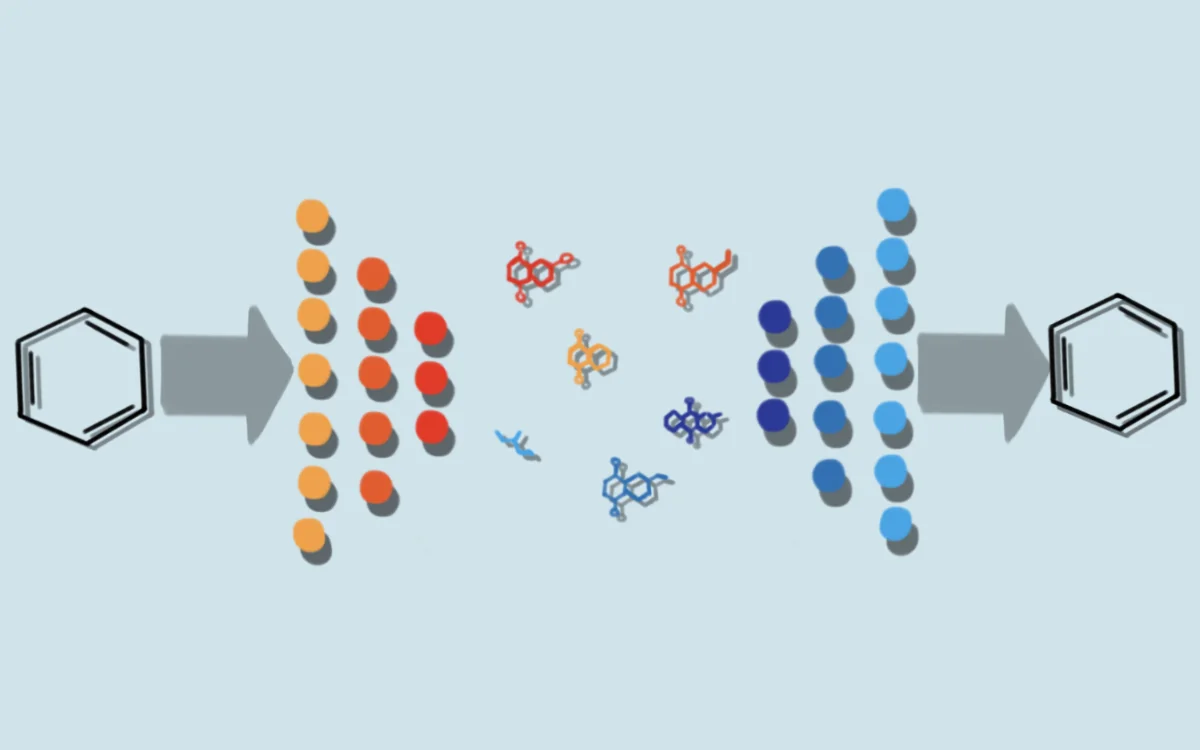
Amongst generative models which exist, the variational autoencoder (VAE) is heavily utilized for small molecular drug discovery due to the presence of its smooth and continuous latent space. A VAE has two neural networks, an encoder that compresses a molecule into a point in that space and a decoder that reconstructs the molecule from the point. The two are trained together by minimizing a single loss that combines a reconstruction error and a penalty that keeps the latent space well organized. As nearby points decode to similar molecules, researchers can move through the latent space and be highly confident in the decoded molecules. Early work from Gómez-Bombarelli and colleagues shows VAEs could be used to search chemical spaces with gradient-based optimization rather than blind trial and error.4
VAEs have resulted in successful synthesis, proving this method is not just theoretical. In 2019, Insilico Medicine reported its generative model GENTRL, a VAE based reinforcement learning algorithm, designed novel inhibitors of the kinase DDR1, with a lead compound being identified and functioning in cells within 46 days.3
AI Misuse
Machine learning and AI based tools hold immense potential for the field of drug discovery, helping develop medicines faster, cheaper, and saving millions of lives. Despite this, the same tools used to develop novel therapeutics can just as easily be repurposed to develop new classes of toxins. This situation is no longer a hypothetical. In its September 2026 report, “Detecting and countering misuse of AI, ” Anthropic described a case in which a researcher used Claude to lead a computational redesign of a toxin implicated in the hemorrhagic-fever virus. The work was framed as being therapeutic in nature, under the umbrella of a national research project. These researchers would write quarterly reports to Anthropic, though deliberately obscuring the identities of the toxin and vir protein. Anthropic swiftly banned these accounts and conducted a full audit, finding the safe guard classifiers were not able to detect malicious activity in time. The report concludes by stating a solution to this is the development of a trusted user program, heavily moderating the use of these AI agents.5
References
(1) Durant, J. L.; Leland, B. A.; Henry, D. R.; Nourse, J. G. Reoptimization of MDL Keys for Use in Drug Discovery. J. Chem. Inf. Comput. Sci. 2002, 42 (5), 1273–1280. https://doi.org/10.1021/ci010132r
(2) Shaw, D. E.; Dror, R. O.; Salmon, J. K.; Grossman, J. P.; Mackenzie, K. M.; Bank, J. A.; Young, C.; Deneroff, M. M.; Batson, B.; Bowers, K. J.; others. Millisecond-Scale Molecular Dynamics Simulations on Anton. In Proceedings of the conference on high performance computing networking, storage and analysis (SC ’09); ACM: Portland, OR, USA, 2009. https://doi.org/10.1145/1654059.1654126
(3) Zhavoronkov, A.; Ivanenkov, Y. A.; Aliper, A.; Veselov, M. S.; Aladinskiy, V. A.; Aladinskaya, A. V.; Terentiev, V. A.; Polykovskiy, D. A.; Kuznetsov, M. D.; Asadulaev, A.; Volkov, Y.; Zholus, A.; Shayakhmetov, R. R.; Zhebrak, A.; Minaeva, L. I.; Zagribelnyy, B. A.; Lee, L. H.; Soll, R.; Madge, D.; Xing, L.; Guo, T.; Aspuru-Guzik, A. Deep Learning Enables Rapid Identification of Potent DDR1 Kinase Inhibitors. Nat. Biotechnol. 2019, 37 (9), 1038–1040. https://doi.org/10.1038/s41587-019-0224-x
(4) Gómez-Bombarelli, R.; Wei, J. N.; Duvenaud, D.; Hernández-Lobato, J. M.; Sánchez-Lengeling, B.; Sheberla, D.; Aguilera-Iparraguirre, J.; Hirzel, T. D.; Adams, R. P.; Aspuru-Guzik, A. Automatic Chemical Design Using a Data-Driven Continuous Representation of Molecules. ACS Cent. Sci. 2018, 4 (2), 268–276. https://doi.org/10.1021/acscentsci.7b00572
(5) Anthropic. Detecting and Countering Misuse of AI: September 2026, 2026. https://www.anthropic.com/threat-intelligence-report-september-2026 (accessed 2026-11-15)
Spotted an error? Email [email protected] from your Wesleyan account.