

Leopards and Tigers and Cats – Oh my!
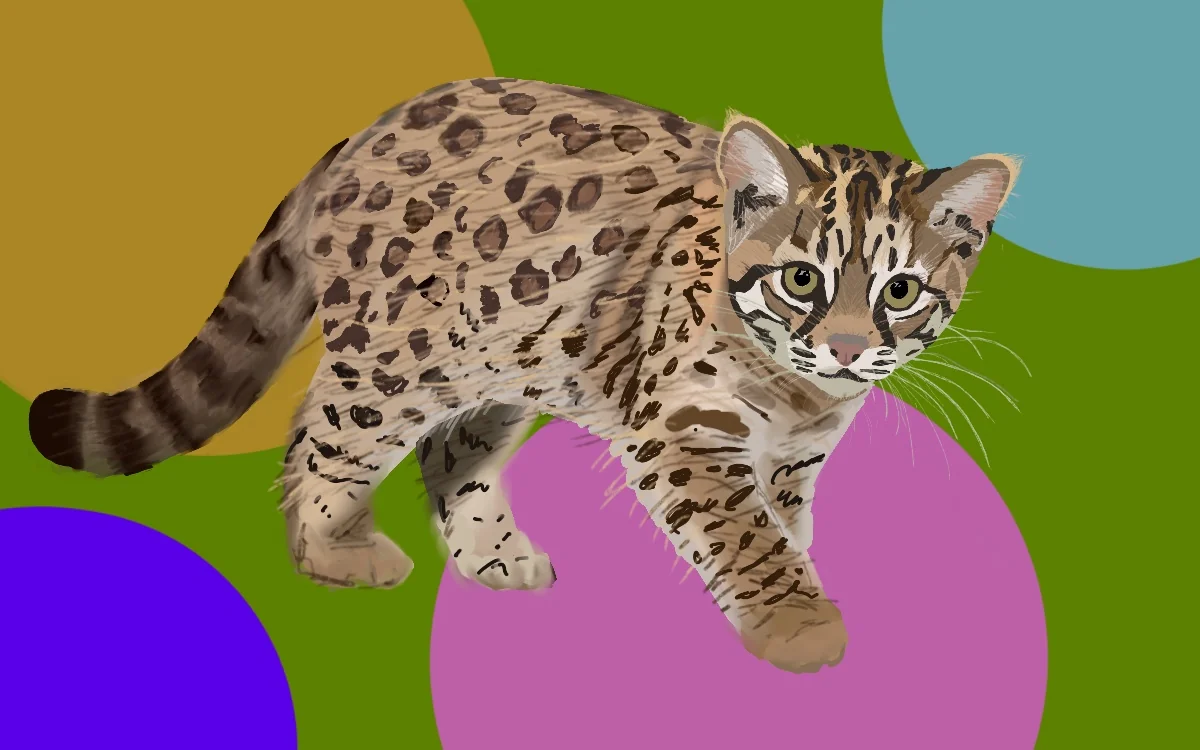
If you’ve got internet access, you’ve probably seen the news about ecology’s newest cat species, Leopardus tilcayo, the “first new cat species discovered in 100 years.”1 The three pound wild cat native to Bolivia has made waves in the news, stealing the hearts of many and even earning its own Google animation. The first of its kind to be discovered was found on the side of a road and taken home as a house pet, then dropped off at a wildlife sanctuary a year later. Matching none of the reference photos in the guidebooks, it was later declared to be an entirely new species.1 However, the undertaking to get from this initial encounter to the publication describing the new species took nearly a decade, collaborations across three continents and more than eight countries, and research efforts in the field, the lab, and museum archives that all too often get overshadowed by Tigrino’s tiny paws.
This new species is part of the Leopardus genus, which is a group of small spotted wild cats native to South and Central America, including the ocelot and margay. Before this latest round of phylogenomic testing, the common name “tiger cat” referred to a contentious species complex made up of several proposed but debated sub-groups.2 The term “species complex” describes a group of closely related taxa with physical characteristics so similar that distinguishing the lines between species is difficult.3
These possible sub-groups include the southern tiger cat (Leopardus guttulus) in the Atlantic forest along the coast of Brazil, the northern tiger cat (Leopardus tigrinus) in the Guiana Shield, the eastern tiger cat (Leopardus emiliae) in the Caatinga and Cerrado ecoregions of central Brazil , and the cloud tiger cat (Leopardus pardinoides) in the Cloud forests of the Andes and Talamanca mountain range.2 The L. pardinoides sub-group also contains a population living in the Yungas forests in the central Andes which had been found to contain a distinct mitochondrial DNA lineage.2 While L. guttulus had been widely accepted as a distinct species, it was still up in the air whether L. emiliae and L. pardinoides species of their own or regional variations of L. tigrinus. These elusive wild cats are tricky to study, and limited data has meant no definitive conclusions had been drawn about the evolutionary relationships of the tiger cat population.1
Biologist Paola Nogales-Ascarrunz of the Bolivian Felids Research Program, geneticist Eduardo Eizirik at Pontifical Catholic University of Rio Grande do Sul, and evolutionary biologist Jonas Lescroart led the study. 18 modern samples came from blood or muscle tissue from road kills or live animals in wildlife rescue centers and eight historical samples were sourced from blood and skin in museum archives and sampled by the Smithsonian Museum of Natural History and the Naturalis Biodiversity Center in the Netherlands.2 The eight museum samples were processed by researchers at University of California Santa Cruz while the fresh samples were sequenced at The Centre for Applied Genomics or at commercial sequencing centers. Whole-genome sequencing (WGS) using Illumina platforms was done for all samples, for a total of 26 generated WGS samples from the Leopardus genus.2
Combined with 12 additional Leopardus genomes and two non-Leopardus genomes from previously published studies, their total dataset included 40 WGS samples. Highlights from this dataset include museum specimens from the Guianas, which have never had DNA sequenced. There are also four modern samples from the central Andes, the population considered part of L. pardinoides but found to have a unique mtDNA lineage.2 Once the raw DNA data was generated, it was cleaned before analysis. Because museum samples degrade to different levels, data cleanup had to be done to eliminate bias caused by post-mortem damage. Then, phylogenomic analysis and divergence time estimates could be run.2
From phylogenomic analysis emerged five distinct species from the single Leopardus tigrinus species complex: L. guttulus, L. emiliae, L. pardinoides, L. tigrinus, and the beloved L. tilcayo.2 They also identified a new subspecies of L. tigrinus named L. tigrinus antisuyo.2 Their analysis tells a story of evolution very different from earlier theories; the tiger cat complex split off from the rest of the Leopardus genus 2.34 million years ago. L. tilcayo diverged 1.43 million years ago, followed by L. emilae and L. guttulus splitting, then L. guttulus, then L. pardinoides.2 The isolation of L. t. antisuyo from L. t. tigrinus happened the most recently. This recent phylogenomic analysis clarifies the long fraught evolutionary history and stabilizes debated taxonomy of the tiger cats.
This taxonomic reclassification is not merely a matter of changing labels and names. Whether or not a group is classified as a single species complex or multiple unique species has ramifications for their conservation and management. Given that the IUCN counts a species complex as a single species, this group would have had a population count that likely far overestimates the true numbers of these five distinct species, a miscalculation which could result in an incorrect conservation status that prevents management actions.2
References
(1) Bittel, J. Meet the First New Cat Species Discovered in 100 Years. National Geographic, September 17, 2026. https://www.nationalgeographic.com/animals/article/meet-the-first-new-cat-species-discovered-in-100-years (accessed 2026-11-15).
(2) Lescroart, J.; Nogales-Ascarrunz, P.; Cassatt-Johnstone, M.; Bonilla-Sánchez, A.; Sartor, C. C.; Angulo, F.; Ramirez, J. L.; De Oliveira, L. R.; De Oliveira, T. G.; Shapiro, B.; Aliaga-Rossel, E.; Svardal, H.; Eizirik, E. Phylogenomics and Museomics Reveal Five Distinct Species of Tiger Cats in South America. Curr. Biol. 2026, 36 (19), 5027–5041.e8. https://doi.org/10.1016/j.cub.2026.08.059.
(3) Saryan, P.; Gupta, S.; Gowda, V. Species Complex Delimitations in the Genus Hedychium: A Machine Learning Approach for Cluster Discovery. Appl. Plant Sci. 2020, 8 (7), e11377. https://doi.org/10.1002/aps3.11377.
Spotted an error? Email [email protected] from your Wesleyan account.