
The Unwanted Visitor: Spotted Lanternflies and Their Threat to Our Environment

Looks can be deceiving. With polka-dot forewings and bright red underwings, spotted lanternflies can be alluring. Their recent abundance in Connecticut, and more specifically by the doors of the Casper Life Sciences building, can spark curiosity, but don’t let these insects entice you.
The spotted lanternfly, otherwise known as Lycorma delicatula, is a highly invasive pest that threatens habitats and agricultural economies throughout the East Coast. Native to areas in China, Vietnam, and Taiwan, spotted lanternflies were first detected in Berks County, Pennsylvania, in 2014. Similar to many other invasive species, they were likely introduced to the United States through imported goods.1
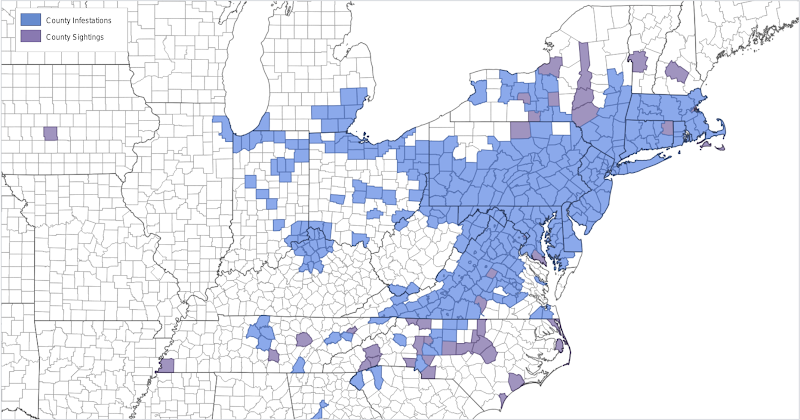
Over the past 12 years, spotted lanternflies have spread across the East Coast at alarming rates and are now seen in over 20 states. For context, the gypsy moth, another highly invasive species, took almost a century to spread from Massachusetts to New York.1 Spotted lanternflies were first reported in Fairfield, Connecticut, in 2020 and today are seen in all eight counties of the state.3
The name “lanternfly” can be misleading, for the insects have little in common with any types of flies. Rather, spotted lanternflies are planthoppers in the order Hemiptera, family Fulgoridae, otherwise known as true bugs. The species is more closely related to cicadas, stink bugs, and leafhoppers. All insects in this genetic order have piercing-sucking mouthparts that allow them to drill into the phloem of a plant to feed directly on the sugary sap. The term “planthoppers” comes from the species’ ability to hop from surface to surface and grip tightly.3
The spotted lanternfly feeds on more than 100 species of plants in North America. Its preferred host is the invasive tree of heaven (Ailanthus altissima), but the species can be found feeding on walnut, butternut, maple, birch, sumac, willow, and other native trees as well.3 Agricultural crops affected include apples, grapes, peaches, plums, cherries, and apricots. While spotted lanternflies are generally unpicky when it comes to host species, their feeding preference varies across life-cycle stages. A young nymph is commonly unselective and feeds on young, tender plant tissue. Adults, on the other hand, prefer woody trees and vines, and target more mature plant tissue.
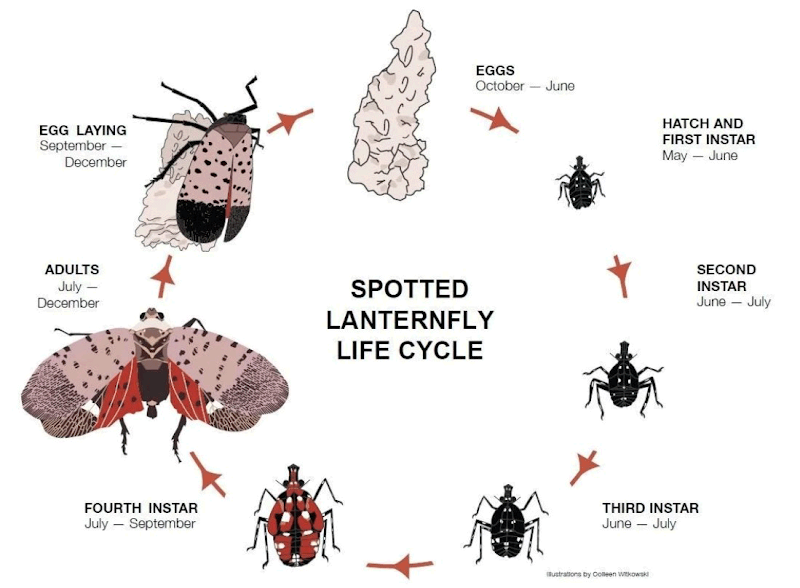
Spotted Lanternflies produce one generation a year, consisting of four nymphal stages, an adult stage, and overwintering as egg masses. Female insects lay eggs from September through December, before the first major freeze occurs. The eggs then mature over the winter, with the first instar nymphs hatching anytime between early May and late June.1 Being true bugs, spotted lanternflies molt to progress between stages, meaning they undergo incomplete metamorphosis by shedding their rigid exoskeleton.1
As mentioned earlier, a unique and damaging aspect of the spotted lanternfly is its piercing-sucking mouthparts that feed on sap from stems, leaves, and trunks. As the insect feeds, excess sugar from the sap is excreted as a liquid waste known as honeydew. The honeydew then attracts other damaging insect species and can support sooty mold growth. Highly threatening, sooty mold can cover leaves, reducing photosynthesis processes and resulting in deterioration of trees. While the insect species cannot bite or sting humans, they are a continued threat to the livelihood of tree and agricultural species within their reach. Economic researchers at Penn State University estimate that in Pennsylvania alone, Spotted Lanternflies will cause approximately $42.6 million in agricultural losses statewide.4 Damage specific to Connecticut’s economy has not been studied, but given the trends from other states, the insect will be sure to have a large impact.
On Wesleyan’s campus, Spotted Lanternflies are seen almost everywhere, but, more recently, are concentrated around the newly constructed Casper Science building, despite it not being a host plant species. Scientific research from the Tom Baker laboratory at Penn State University explains this behavior. Spotted lanternflies are naturally drawn towards tall, warm objects.2 While this behavior is a natural instinct for tree and host detection, large infrastructure can confuse the insects and attract them nonetheless. Casper, being a tall and warm building, is a magnet for Spotted Lanternflies working to survive the first freeze events. Additionally, the insects are not well-adapted fliers. They can jump and glide from host to host but not inherently fly. Rather, they work to climb to the tops of trees, poles, and buildings, then jump off and glide to new hosts. On their own, they are able to move 3 to 4 miles by walking, jumping, and gliding.3 This behavioral trait could be another reason why the insects are attracted to Casper — a high building that could help them spread to new regions.
While their ecological impact and spread are transforming our environments in frightening ways, there are actions that we can take. Traps can be useful to catch spotted lanternfly nymphs and adults as they climb up tree trunks. Although this method can trap a large number of the insects, it does not completely stop the presence of lanternflies. Scientists are currently working on spotted lanternfly specific insecticides and biocontrols. Egg mass scraping and insect squashing are some of the biggest ways individuals can stop the spread. If you see any of the egg sacks, which can be located on any hard surface, including plastic, metal, or wood, scrape the eggs and smash them effectively. Each egg mass contains roughly 50 eggs, so this process can reduce population numbers significantly.1
Whether seeking refuge at the Casper doors or jumping onto your shoulder as you sit outside, spotted lanternflies represent a larger ecological concern. Since their introduction to the United States, they have spread to new regions at alarming rates, damaging agricultural crops and local wildlife, and reshaping entire environments. Through educating ourselves on spotted lanternfly distribution, lifecycles, and, most importantly, their impact, we are closer to stopping the spread of these invasive pests.
Work Cited
1. Andrews, C. Stopping the Spotted Lanternfly in Its Tracks. U.S. Fish & Wildlife Service. https://www.fws.gov/story/stopping-spotted-lanternfly-its-tracks (accessed November 13, 2026).
2. Duke, A. Lanternfly’s Attraction to Vertical Silhouettes Could Help Monitor, Trap It. Penn State University, April 26, 2021. https://www.psu.edu/news/research/story/lanternflys-attraction-vertical-silhouettes-could-help-monitor-trap-it (accessed November 13, 2026).
3. Kunschaft, C.; Lentz, E.; Kurtz, L. Spotted Lanternfly. UConn Extension, May 2026. https://extension.uconn.edu/publication/spotted-lanternfly/ (accessed November 13, 2026).
4. Penn State Extension. Spotted Lanternfly. https://extension.psu.edu/spotted-lanternfly (accessed November 13, 2026).
Spotted an error? Email [email protected] from your Wesleyan account.